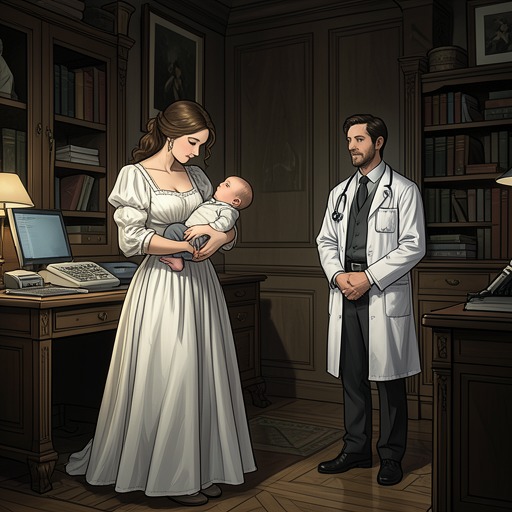
Tita Accepts John Brown’s Proposal
Like Water for ChocolateTita’s acceptance of John Brown’s proposal turns a private possibility into a public engagement, but it does not settle the conflict between the life she hopes to leave behind and her enduring attachment to Pedro. At a family gathering marked by tension, John asks for her hand, Pedro gives his approval, and a diamond ring makes the commitment visible. Tita’s response is sincere enough to proceed, yet her thoughts and reactions reveal that the decision is not emotionally uncomplicated.
Background and divided loyalties
At Mama Elena’s funeral, Tita had mourned not only the mother who had constrained her but also the woman whose own love had been frustrated. She vowed that she would never renounce love. At that moment, John’s steady support made him seem to her the person she could truly love. But when Pedro appeared at the funeral with Rosaura, Tita’s certainty weakened. Pedro’s embrace stirred her, even as she judged him for having left her and resolved that he did not deserve her love. On the journey back, she took John’s arm partly to make Pedro feel the hurt she had experienced when he stood beside her sister.
That history accompanies John’s proposal. In the interval before his arrival, Tita sees Pedro watching her through gaps in the bathroom boards and hurries away. Chencha then tells her that John is waiting in the living room. The sequence places the proposal immediately after a reminder of Tita’s attraction to Pedro: John arrives not into an emotional vacuum but into a household where her competing attachments remain active.
The proposal and engagement
Tita cannot go straight to John because the dining table has not been prepared. She lays out the table cover, dishes, glasses, saltcellars, and knifeholders, and arranges candles beneath the plate warmers. The ordinary work of hosting delays her entry into the living room, where she listens from the adjoining rooms and hears John and Pedro arguing about the country’s political situation. Her arrival interrupts their discussion and brings the gathering back to its social purpose.
In that tense setting, John asks for Tita’s hand. Pedro, acting as the man of the house, gives his approval sullenly. The group then discusses a wedding date. John wants to postpone the ceremony so he can travel to the northern United States and bring back his only living aunt, whom he wants present. For Tita, the delay creates a practical and emotional difficulty: she wants to leave the ranch, and Pedro’s proximity, as soon as possible. The proposal offers a route away, but John’s wish to wait keeps that departure from being immediate.
John gives Tita a diamond ring to formalize their engagement. As she studies its light on her finger, she recalls a poem Nacha taught her as a child, whose images connect a drop of dew, sunlight, and the beloved as the light of one’s eyes. The remembered verse links the ring’s brightness with Pedro’s eyes as she had seen them shortly before. The moment does not undo her acceptance; instead, it makes visible the unresolved feeling that accompanies it.
Public acknowledgment and immediate aftermath
Rosaura sees tears in Tita’s eyes and understands them as happiness. That interpretation eases some of the guilt Rosaura sometimes feels for having married the man Tita loved. She pours champagne and proposes a toast to the engaged couple. When the four gather to drink, Pedro strikes his glass against the others so forcefully that it breaks, scattering fragments and spilling champagne onto their clothes and faces. The attempted celebration briefly gives form to the strain that the engagement has not removed.
Chencha’s announcement that supper is served restores the gathering’s composure. The meal proceeds pleasantly, although Tita’s bad temper has affected the food; the champandongo, however, remains enjoyable. When supper is over, Tita walks John to the door and gives him a farewell kiss. He is planning to leave the following day so that he can return as soon as possible. The engagement therefore ends not in a wedding but in a separation shaped by John’s journey and the couple’s intention to continue toward marriage.
Significance and later terms
The proposal gives Tita a prospective escape from the ranch, yet the surrounding circumstances make clear that leaving does not equal emotional resolution. Her commitment to John coexists with her response to Pedro, and the ring’s association with the childhood poem cannot erase that divided attention. The public toast likewise places the engagement inside a family structure in which Pedro’s approval and Rosaura’s interpretation help frame the couple’s decision, even as Pedro’s broken glass exposes the unease beneath the ceremony.
Later, Tita, Pedro, and Rosaura make a pact that protects the appearance of Rosaura’s successful marriage while requiring Tita and Pedro to keep their meetings secret. Its terms include Tita’s agreement not to have an illicit child, while Rosaura permits her to share in Esperanza’s care. This later arrangement shows that Tita’s engagement to John did not permanently resolve her relationship with Pedro. The proposal remains a real commitment in the story, but its meaning is shaped by the affection, secrecy, and family obligations that continue beyond the evening of the toast.